
Quick Answer
The NASA TLX is a short, validated questionnaire that measures how demanding a task feels to the person doing it. It scores six dimensions: mental demand, physical demand, temporal demand, performance, effort, and frustration.
To find out whether an AI tool actually lightens your workforce’s load, run the NASA TLX on a task before the tool is introduced, then again after personnel have used it for a few weeks. Compare the overall score and each subscale. The results show where AI reduced the burden, where it shifted it, and where training needs to focus.
Key Facts
- Origin. The NASA TLX was developed by Sandra Hart and Lowell Staveland at NASA Ames Research Center, with the foundational work published in 1988.
- Six subscales. It rates mental demand, physical demand, temporal demand, performance, effort, and frustration.
- Two scoring methods. The original weights each subscale using 15 pairwise comparisons. A simplified version, often called Raw TLX, skips the weighting and averages the ratings.
- Broad use. A 2006 review by Hart covered 550 studies and found the tool had spread well beyond aviation into medicine, power plants, automobiles, and computer interfaces.
- Free and official. NASA provides the instrument as a paper-and-pencil form and as an official iOS app.
- Known limits. Hart’s review notes that the subscales correlate with each other, that context affects ratings, and that there is no agreed “redline” score signaling dangerous overload.
Why the NASA TLX Belongs in Every AI Rollout Plan
Every AI rollout comes with the same promise: the tool will take work off people’s plates. Most organizations never check whether it did.
They measure adoption, logins, and completion rates. Those numbers show that people are using the tool. They say nothing about whether the job got easier, harder, or just different.
That gap matters more than it seems. In 1983, engineering psychologist Lisanne Bainbridge described what she called the ironies of automation. Automating the routine parts of a job tends to leave people with the hardest parts, plus the new task of monitoring the machine. AI can follow the same pattern.
The NASA TLX gives training officers a practical way to see it happening. It’s quick, it’s free, and it has decades of research behind it. Most importantly, it puts a number on something leaders usually hear about only through complaints or burnout.
What the NASA TLX Actually Measures
The instrument asks people to rate a specific task they just completed across six dimensions. Each one captures a different kind of load, and AI tends to affect them unevenly.
| Subscale | What it asks | How AI can change it |
|---|---|---|
| Mental demand | How much thinking, deciding, and remembering was required? | Can drop for drafting and searching, or rise when outputs must be checked |
| Physical demand | How much physical activity was required? | Usually minor for desk work |
| Temporal demand | How much time pressure did you feel? | Can drop, or rise if leaders expect faster turnaround because “AI does it” |
| Performance | How successful were you at the task? | Can rise with good tools, or fall if people distrust the output |
| Effort | How hard did you have to work to reach that level? | Often shifts from producing work to reviewing it |
| Frustration | How irritated, stressed, or discouraged did you feel? | Rises quickly with unreliable tools or unclear rules |
The value is in the pattern across subscales, not just the total. An AI tool might cut effort while raising frustration. That calls for a very different fix than a tool that raises mental demand because every output needs heavy verification.
How to Run a NASA TLX Baseline Before and After AI
You don’t need a research lab to do this well. You need a consistent task, a consistent group, and discipline about timing.
1. Pick one representative task. Choose something personnel do often and that the AI tool is meant to help with, such as drafting a routine report or summarizing incoming material. Keep the task definition identical for both rounds.
2. Collect the baseline first. Have a group complete the task the current way, then fill out the NASA TLX right away while the experience is fresh. Delayed ratings drift, and context affects scores.
3. Train, then wait. Introduce the AI tool with training and give people a few weeks to get past the learning curve. Measuring on day one mostly captures the unfamiliarity of a new tool.
4. Measure again under the same conditions. Use the same task, the same group where possible, and the same scoring method. Changing any of these makes the comparison unreliable.
5. Read the subscales, not just the total. A flat overall score can hide a meaningful shift, such as lower effort offset by higher frustration. The breakdown is where the training insights are.
Weighted or Raw NASA TLX: Choosing Your Scoring Method
The original method asks respondents to compare every pair of subscales and pick the one that mattered more to their workload. Those 15 choices produce personal weights. The simplified Raw TLX drops that step and averages the six ratings.
| Method | Advantages | Drawbacks |
|---|---|---|
| Weighted NASA TLX | Reflects what each person considers most important; follows the original design | Takes longer; adds friction in busy operational settings |
| Raw TLX | Faster and simpler; easier to administer at scale | Loses individual weighting; research on its sensitivity is mixed |
Hart’s 2006 review found studies reporting Raw TLX as more sensitive, less sensitive, or about as sensitive as the weighted version. For most workforce readiness work, Raw TLX is a reasonable choice. What matters most is picking one method and sticking with it across every round.
Common Mistakes That Undermine NASA TLX Results
The tool is simple, which makes it easy to misuse. A few errors show up again and again.
Treating the score as a universal grade. There is no official threshold that marks a score as too high. The NASA TLX is strongest as a comparison tool: the same task, before and after a change.
Comparing different tasks. A score for drafting a memo can’t be meaningfully compared to a score for reviewing a contract. Keep the task constant.
Collecting scores without context. Scores are subjective. Pair them with a short follow-up question, such as what made the task hard, so you can explain the numbers.
Reporting only the average. Leadership usually wants one number. Give it to them, but also show the subscale that moved the most. That’s usually where the story is.
Turning NASA TLX Scores Into Training Decisions
The point of measuring is to act on the results. Each subscale pattern points toward a different response.
If mental demand rose after AI arrived, personnel are likely spending more time verifying outputs than they saved producing them. Training should focus on efficient verification: what to check, what to spot-check, and when to reject an output outright.
If frustration rose, look at tool reliability and rules first. People get frustrated when outputs are inconsistent or when nobody has told them what they’re allowed to use the tool for. Clear guidance can fix this faster than more training.
If temporal demand rose, the problem may be leadership expectations, not the tool. When supervisors assume AI makes everything instant, deadlines tighten and the workload gain disappears. That’s a conversation to have with leaders, backed by data.
If scores dropped across the board, you have evidence the rollout is working. That’s worth documenting, especially when defending a budget or expanding the tool to other teams.
Making the NASA TLX Part of AI Readiness
AI integration changes how work feels long before the change shows up in output metrics. By the time burnout or quiet workarounds appear, the cost has already been paid.
The NASA TLX gives training officers and human-systems professionals a way to catch those shifts early. It’s short enough to run in operational settings and established enough to hold up in front of leadership. Used before and after a rollout, it turns “the tool should help” into evidence of whether it did.
The technology will keep evolving. Measuring its effect on the people using it should be a standard part of every rollout.
Go Deeper: Operationalizing the Human Element
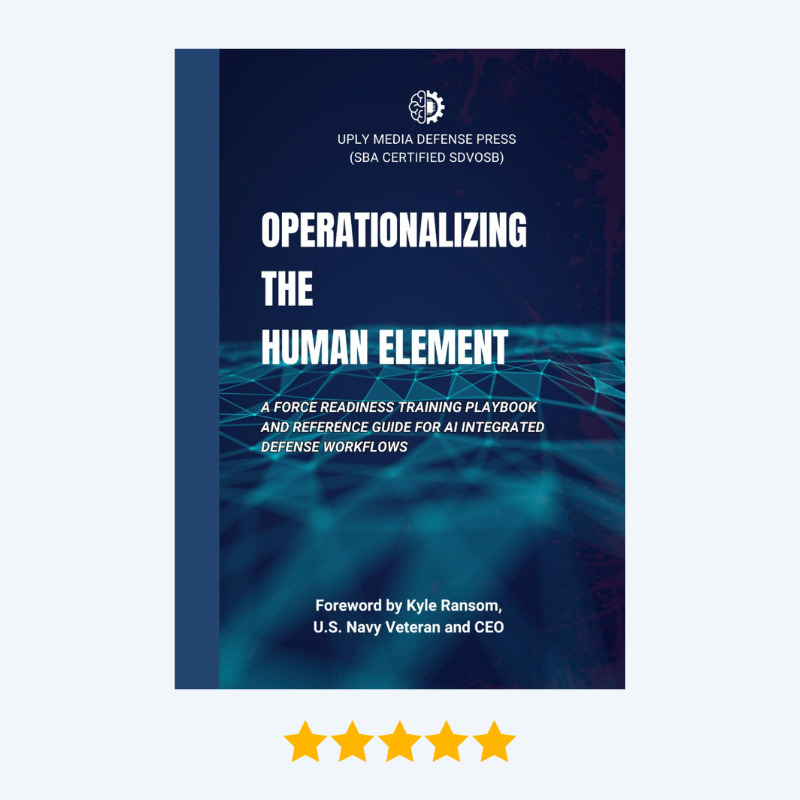
The NASA TLX is one tool in a broader human-systems toolkit. Operationalizing the Human Element: A Force Readiness Training Playbook and Reference Guide for AI Integrated Defense Workflows devotes a full chapter to cognitive workload and the NASA TLX. It connects workload measurement to human-machine trust, adoption, human-in-the-loop governance, and operational checklists you can put to use right away.
Purchase with a Government Purchase Card on Amazon →
Government purchase card use is subject to agency purchasing rules and cardholder authority.
Equipping a team, schoolhouse, or program office? Request bulk or organizational copies →
Need support beyond the book? Discuss your training and readiness requirements with Uply Media →
Related reading: AI Workforce Readiness Training: Why It Fails and How to Fix It | AI and CUI Training: What Your Workforce Needs to Know Now | About the book
Frequently Asked Questions
How long does it take to complete the NASA TLX?
The Raw TLX version takes most people just a few minutes, since it’s six ratings. The weighted version adds 15 quick pairwise comparisons. Either is short enough to run right after a task in an operational setting.
Is the NASA TLX free to use?
Yes. NASA makes the instrument available as a paper-and-pencil form and through an official iOS app. There is no licensing requirement to administer it for internal workforce assessment.
What is a good NASA TLX score?
There isn’t a universal “good” score. Workload depends heavily on the task, and Hart’s own review notes that no redline threshold has been established. The NASA TLX is most useful for comparing the same task under different conditions, such as before and after an AI tool is introduced.
Can the NASA TLX be used for non-aviation work?
Yes. Although it was developed at NASA for aviation research, it has been applied in medicine, power plants, automobiles, and computer interfaces. Desk-based knowledge work, including AI-assisted tasks, is a reasonable fit.
How many people do I need for a useful NASA TLX comparison?
There’s no fixed minimum for internal readiness work, but larger groups give more stable averages. A small team can still reveal clear subscale patterns, especially when scores are paired with short written explanations from participants.
Should the NASA TLX replace performance metrics?
No. Use it alongside output measures like quality, error rates, and turnaround time. Performance data shows what got done. The NASA TLX shows what it cost the people doing it.

Leave a Reply