

Human-in-the-loop means a person reviews, approves, or can override what an AI system produces before it becomes a decision. Most programs treat it as a box to check: a name on the approval line.
In practice, human-in-the-loop oversight only works when the person has the skill to catch errors, the time to look, and the authority to say no. Training should build those three things directly. That means scenarios with deliberately flawed AI outputs, verification effort matched to the stakes of the decision, and competency checks instead of attendance records.
Key Facts
- DoD’s ethical principles expect human judgment. Adopted in February 2020, the DoD AI Ethical Principles state that personnel will exercise appropriate levels of judgment and care. They also require AI systems to be governable, meaning the systems can be disengaged if they behave in unintended ways.
- The weapons directive requires judgment, not a “loop.” DoD Directive 3000.09, updated in 2023, requires appropriate levels of human judgment over the use of force. As defense analyst Michael Horowitz has noted, the phrase “human in the loop” does not appear in the directive.
- Federal policy now requires operator training. OMB Memorandum M-25-21 requires agencies using high-impact AI to give operators periodic, system-specific training and competency assessments, along with human oversight and ongoing human review. Agencies had until April 2026 to comply with these minimum practices.
- Human oversight has a research basis. Human factors research has long described automation in stages, from gathering information to taking action, with the level of human involvement varying at each stage.
Why Human-in-the-Loop Oversight Breaks Down
On paper, almost every AI workflow has a human in it. Someone reviews the output, signs off, and passes it along. The org chart says oversight exists.
The reality often looks different. A reviewer facing forty AI-generated summaries before noon isn’t really reviewing forty summaries. They’re skimming, trusting, and signing. The human is present, but the judgment isn’t.
This is the core problem with treating human-in-the-loop as a checkbox. It measures whether a person touched the output, not whether they could have caught a problem. Three conditions make the difference: skill, time, and authority.
A reviewer without the skill to spot a plausible-sounding error will miss it. A reviewer without time will skip the check. A reviewer without real authority to reject the output, or who fears the consequences of slowing things down, will approve it anyway.
In the Loop, On the Loop, or Out of It
Oversight isn’t one thing. The terms get used loosely, but they describe very different levels of human involvement, and each one demands different skills.
| Level | What the human does | Skill it requires |
|---|---|---|
| Human in the loop | Reviews and approves each output before it’s used | Error detection, source checking, confidence to reject |
| Human on the loop | Monitors the system and intervenes when something looks wrong | Sustained attention, pattern recognition, knowing when to step in |
| Human out of the loop | The system acts without routine human review | Designing limits and audits up front, and reviewing results after the fact |
Each level fits different situations. The mistake is labeling a workflow human-in-the-loop when the reviewer is really just on the loop, glancing at results as they go by. Training officers should name the actual level honestly, then train for the skills that level really requires.
What Real Human-in-the-Loop Verification Looks Like
Effective reviewers don’t reread everything. They know where AI tends to fail, and they check there first.
They know the tool’s weak spots. Generative AI can produce confident, fluent text that is wrong. It can cite sources that don’t say what it claims, or miss the one detail that changes the answer. A trained reviewer goes straight to names, numbers, dates, and citations.
They check against the source, not the output. Rereading an AI summary tells you whether it reads well. Comparing it to the underlying document tells you whether it’s right. That distinction is the heart of verification.
They match effort to consequence. A routine internal note doesn’t need the same scrutiny as a finding that will reach a decision-maker. Skilled reviewers adjust how deeply they check based on what happens if the output is wrong.
They’re willing to reject. Human-in-the-loop review only matters if the human sometimes says no. A reviewer who has never rejected an output is either working with a flawless tool or not really reviewing.
Matching Verification to the Stakes
Checking everything thoroughly sounds safe, but at scale it isn’t realistic. When reviewers can’t keep up, they quietly stop checking at all. A proportional model is more honest and holds up better over time.
| Consequence if wrong | Example | Verification level |
|---|---|---|
| Low | Internal meeting notes, first-draft brainstorming | Quick read for obvious errors |
| Moderate | Staff summaries, routine correspondence, training materials | Spot-check key facts against sources |
| High | Findings that inform leadership decisions, or anything touching people’s rights, safety, or funding | Full source verification and a documented human decision |
The trade-off is real. Proportional verification saves time and keeps reviewers from burning out, but it accepts some risk on lower-stakes work. Full verification everywhere catches more errors on paper, but under real workloads it tends to collapse into rubber-stamping. For most organizations, a clearly defined proportional model enforces human-in-the-loop oversight better than an unworkable universal rule.
How to Train Human-in-the-Loop as a Skill
If oversight is a skill, it can be taught, practiced, and assessed. Here’s what human-in-the-loop training looks like in practice.
Train with flawed outputs. Build exercises where the AI output contains planted errors: a wrong figure, a misattributed source, or a conclusion the evidence doesn’t support. Reviewers who find them build the reflex. Reviewers who miss them learn something no slide deck can teach.
Practice under realistic pressure. Verification that works in a quiet classroom often fails at a real desk. Add time limits and volume to exercises so personnel learn to prioritize checks the way they’ll have to on the job.
Rehearse the rejection. Walk through what happens when a reviewer rejects an output: who they tell, how they document it, and what happens next. People are more likely to push back when they’ve practiced doing it and know it’s expected.
Assess competency, not attendance. M-25-21 calls for competency assessments for operators of high-impact AI. That’s a useful standard for any AI-assisted workflow. Test whether people can actually catch errors, not just whether they finished the course.
Watch the override rate. Track how often reviewers reject or correct AI outputs. A rate near zero is a warning sign, not a success metric. It usually means the review has become a formality.
Making Human-in-the-Loop Oversight Real
Policy has already settled whether humans should stay in charge of AI-assisted decisions. The harder question is whether the humans in those workflows are prepared to do the job.
Human-in-the-loop oversight is only as strong as the person in the loop. That person needs the skill to spot a convincing error, the time to check what matters, and the backing to say no. None of that comes from a signature line.
For training officers and AI officers, the task is to stop certifying presence and start building judgment. That’s what the policies ask for, and it’s what the mission needs.
Go Deeper: Operationalizing the Human Element
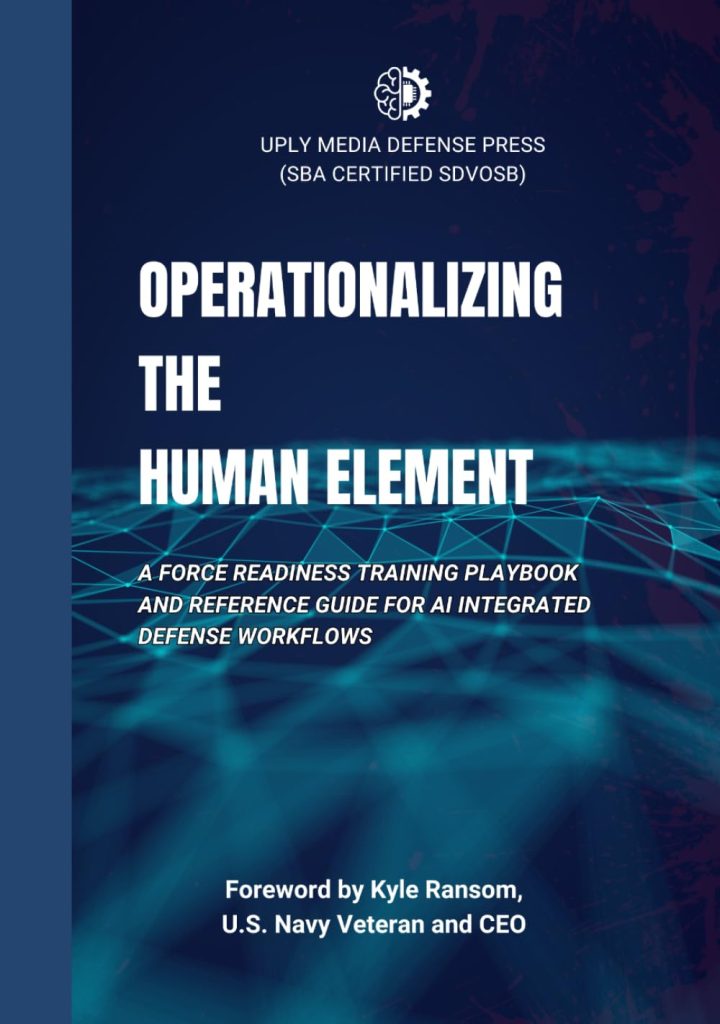
Operationalizing the Human Element: A Force Readiness Training Playbook and Reference Guide for AI Integrated Defense Workflows includes a full chapter on human-in-the-loop governance, human verification, and operational control. It connects oversight to human-machine trust, cognitive workload, CUI-aware workflows, and operational checklists your teams can put to use right away.
Purchase with a Government Purchase Card on Amazon →
Government purchase card use is subject to agency purchasing rules and cardholder authority.
Equipping a team, schoolhouse, or program office? Request bulk or organizational copies →
Need support building human-in-the-loop training for your organization? Discuss your training and readiness requirements with Uply Media →
Related reading: AI Workforce Readiness Training: Why It Fails and How to Fix It | NASA TLX for AI Workflows | About the book
Frequently Asked Questions
What is the difference between human-in-the-loop and human-on-the-loop?
Human-in-the-loop means a person reviews and approves each output before it’s used. Human-on-the-loop means the system runs on its own while a person monitors it and steps in when something looks wrong. The two call for different skills, so training should match the level actually in place.
Does DoD policy require a human in the loop for AI?
Not in those words. DoD Directive 3000.09 requires appropriate levels of human judgment over the use of force, and the DoD AI Ethical Principles call for appropriate judgment and care. The standard is informed human judgment and accountability, which is exactly why oversight has to be trained as a skill.
What does M-25-21 require for AI operators?
For high-impact AI, M-25-21 requires periodic, system-specific operator training, competency assessments, human oversight, and ongoing human review, along with other minimum risk practices. Agencies had until April 2026 to comply.
How do you know if human-in-the-loop review is actually working?
Look at the override rate, meaning how often reviewers correct or reject AI outputs, and test reviewers with planted errors. If overrides are near zero and planted errors slip through, the review has turned into a formality.
Should every AI output get full human review?
Not usually. Full review of everything tends to collapse under real workloads. A proportional model, with light checks for low-stakes work and full source verification for high-consequence decisions, is more sustainable and more effective.
Who should receive human-in-the-loop training?
Anyone who approves, signs off on, or acts on AI-generated work. That includes analysts, supervisors, and program staff, not just technical AI teams. Leaders need it too, since they set how much time and authority reviewers really have.

Leave a Reply