

Quick Answer
AI workforce readiness training usually fails after the course ends, not during it. Adoption breaks down in two directions. Some personnel quietly stop using the tool, which is adoption resistance. Others keep using it but gradually stop checking its output, which is decision drift. The fix is to run AI workforce readiness training as a sustained readiness function instead of a one-time event. That means recurring decision simulations with deliberate AI errors built in, supervisors who reinforce verification on the job, after-action reviews that examine AI-assisted decisions, and metrics that measure behavior rather than completion.
Why AI Workforce Readiness Training Fades After the Classroom
Most organizations can prove their people completed AI workforce readiness training. Far fewer can prove their people are ready to work with AI.
Anyone who has run a training program knows the pattern. A new AI capability arrives, a course is stood up, completion rates climb toward 100 percent, and the requirement is marked green. Then the workforce goes back to its real jobs, with real deadlines and real supervisors. Whatever habits the course tried to build now compete with the habits that were already there, and the old habits usually win.
This isn’t a new problem. Skills that aren’t practiced decay, and the forgetting curve has been documented for more than a century. With AI workforce readiness training, though, the stakes are higher because the tool doesn’t stay still. Models get updated, interfaces change, and use cases expand faster than most training cycles can follow.
For DoD components and civilian agencies alike, this is the readiness gap that matters most. Technical capability can be procured. Human readiness has to be built, measured, and maintained, and that is where AI workforce readiness training either earns its place in the budget or doesn’t.
The Two Ways AI Adoption Breaks Down
When AI workforce readiness training stops at the course, adoption rarely fails in an obvious way. It shows up as one of two quiet patterns.
The first is adoption resistance. Personnel go back to the old way of doing things. The tool sits unused, or it gets used just enough to satisfy a reporting requirement. Leadership believes the capability is fielded, but in practice it’s shelfware.
The second is decision drift, and it’s the harder one to catch. Personnel use the tool every day, but over time they stop questioning it. A recommendation that once got a second look now gets accepted on sight. Verification becomes a formality, and then it disappears.
Human factors researchers have described these patterns for decades as the disuse and misuse of automation. What has changed is the reach. AI now touches intelligence analysis, logistics, acquisition, personnel actions, and training itself. That’s why AI workforce readiness training has to address both failure modes, not just tool proficiency.
What Decision Drift Looks Like on the Ground
Decision drift doesn’t announce itself. No one decides to hand their judgment over to a model. It happens a little at a time.
Consider an analyst using an AI tool to summarize reporting. In the first week, they check every summary against the source material. By the second month, they spot-check. By the sixth month, the summary is the source, and nobody on the team remembers the last time someone opened the underlying documents. Each step made sense at the time. Taken together, the human is now in the loop in name only.
Sociologist Diane Vaughan described a similar pattern in her study of the Challenger disaster, which she called the normalization of deviance. Small departures from standard become the new standard because nothing bad happened the last time. Decision drift follows the same logic. Every time the AI is right and the check was skipped, skipping the check gets a little easier.
Here’s what training officers need to understand. Drift usually starts because the tool performs well. A reliable system earns trust, and unchecked trust turns into dependence. AI workforce readiness training that covers only how to use the tool, and not when to doubt it, speeds this process up.

Adoption Resistance Is Usually a Signal, Not a Defect
It’s tempting to treat resistance as a people problem: the workforce is stubborn, change-averse, or behind the curve. That diagnosis is usually wrong, and it leads to the wrong fix.
Resistance is often a rational response to something the rollout didn’t address. Personnel may not know who is accountable when an AI-assisted decision goes wrong. They may have seen the tool fail and received no explanation. The tool may add steps to a workflow that was already stretched thin. Or they may be unsure what information they’re allowed to put into it, so they avoid it rather than risk a spill.
Each of these is a gap in AI workforce readiness training and governance, not a motivation gap. Another mandatory course won’t close it. What closes it is clear accountability, honest guidance on the tool’s limits, and practice in realistic conditions until using the tool correctly feels routine.
Good training officers treat resistance as data. When a unit won’t use a capability, its reasons usually point straight to what the next round of AI workforce readiness training needs to cover.
How to Build AI Workforce Readiness Training That Sustains
Readiness is a condition you maintain, not a milestone you reach. AI workforce readiness training should be built the same way. Five practices separate programs that hold from programs that fade.
Train on failure, not just function. Synthetic decision simulations let personnel practice with AI outputs that are deliberately wrong, incomplete, or overconfident. The goal is to build the reflex to verify before a real error shows up. If every scenario in your AI workforce readiness training shows the AI performing well, the course is teaching overreliance.
Move from events to a cadence. Replace the one-time course with recurring AI workforce readiness training: short refreshers timed to tool updates and real mission cycles. Fifteen focused minutes each quarter will do more for readiness than a four-hour block nobody revisits.
Put supervisors in the loop. First-line leaders set what “normal” looks like. If a supervisor never asks how an AI-assisted product was checked, the workforce learns that checking is optional. Give supervisors simple prompts and checklists they can use in daily routines.
Bring AI into after-action reviews. When an AI tool contributed to a decision, the AAR should ask what the tool recommended, what the human verified, and where judgment was applied. This makes drift visible before it becomes a pattern.
Measure behavior, not completion. Completion rates and satisfaction scores show that training happened. They don’t show whether AI workforce readiness training actually produced readiness. Track observable behavior on the job instead: verification rates, override rates, and the quality of AI-assisted work products.
Making AI Workforce Readiness Training Stick
The organizations that get AI integration right won’t be the ones with the most advanced tools. They’ll be the ones whose people know how to use those tools well, and when not to use them at all.
For training officers, AI officers, and workforce development leaders, that means asking a different question. The question isn’t “Has everyone completed the course?” but “Six months from now, will our people still be exercising judgment?” Adoption resistance and decision drift are both predictable, and both can be prevented. Neither goes away with a single round of AI workforce readiness training.
The technology will keep changing. The responsibility for sound decisions won’t. It stays with the people, and preparing them for it is the real readiness mission.
Go Deeper: Operationalizing the Human Element
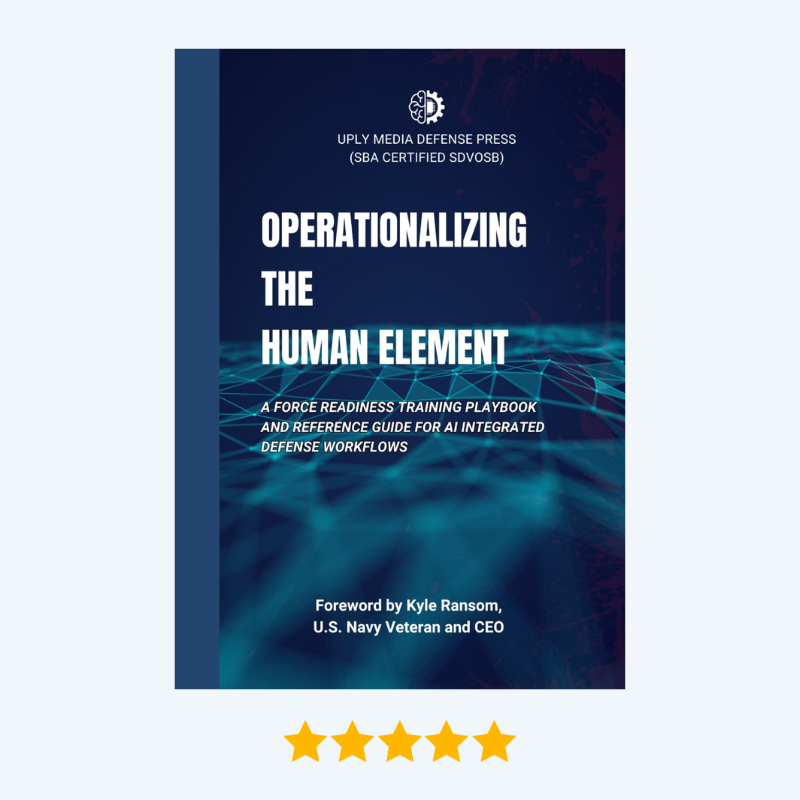
This article covers two of the core challenges examined in Operationalizing the Human Element: A Force Readiness Training Playbook and Reference Guide for AI Integrated Defense Workflows, published by Uply Media Defense Press.
Across twelve chapters, the manual gives training and readiness professionals a practical framework for AI workforce readiness training. It covers human-machine trust, cognitive workload, organizational adoption, synthetic decision simulations, human-in-the-loop governance, CUI-aware workflows, and operational checklists you can put to use right away.
Purchase with a Government Purchase Card on Amazon →
Government purchase card use is subject to agency purchasing rules and cardholder authority.
Equipping a team, schoolhouse, or program office? Request bulk or organizational copies →
Need support beyond the book? Discuss your training and readiness requirements with Uply Media →
Learn more on the Operationalizing the Human Element page →
Frequently Asked Questions
What is AI workforce readiness training?
AI workforce readiness training prepares personnel to use AI tools effectively and responsibly in their actual jobs. It goes beyond teaching how a tool works. It builds the judgment to verify AI output, recognize its limits, protect sensitive information, and keep human accountability for decisions.
What is decision drift in AI adoption?
Decision drift is the gradual, often unnoticed shift of judgment from a person to an AI tool. It happens when repeated reliance on accurate outputs leads users to stop verifying them. Over time, human oversight becomes a formality, even though no one ever decided to give it up.
Why do employees resist adopting AI tools?
Resistance usually comes from unresolved concerns, not stubbornness. Common causes include unclear accountability for AI-assisted decisions, poor fit with existing workflows, uncertainty about what data can be entered, and past tool errors that were never explained.
How can DoD training officers prevent overreliance on AI?
Build scenarios where the AI is deliberately wrong so personnel practice catching errors. Reinforce verification through supervisors and after-action reviews, and run short recurring refreshers instead of one-time courses.
What are synthetic decision simulations in AI training?
Synthetic decision simulations are structured exercises that place personnel in realistic scenarios involving AI-generated recommendations. The best ones include flawed or ambiguous outputs, so trainees build the habit of applying judgment under pressure before they face it in real operations.
How do you measure the effectiveness of AI workforce readiness training?
Look past completion rates and satisfaction surveys. Stronger measures include observed verification behavior, how often personnel correctly override AI recommendations, the quality of AI-assisted work products, and findings from after-action reviews.
Is Operationalizing the Human Element available for government purchase?
Yes. The manual is available on Amazon and can be bought with a government purchase card, subject to agency rules and cardholder authority. Bulk and organizational copies can be requested directly through Uply Media.

Leave a Reply