
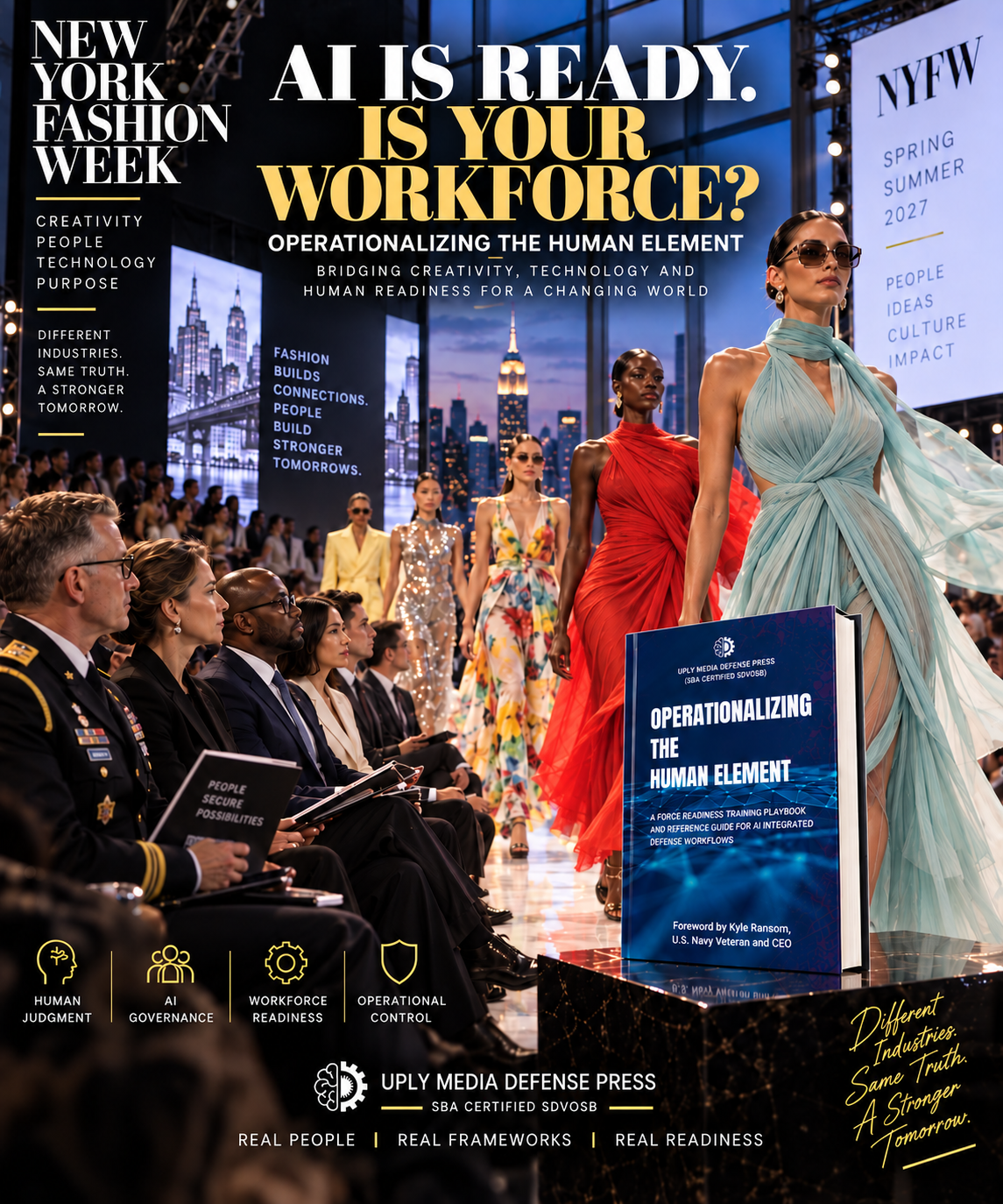
Why Uply Media Defense Press Put a 465-Page Defense Readiness Manual in the Middle of the New York Fashion Week Conversation
By CR Cataunya Ransom
Co-Founder & Chief Marketing Officer, Uply Media, Inc.
For our first New York Fashion Week editorial campaign, we did something you probably would not expect from a defense publisher.
We put a 465-page force-readiness manual on the runway.
Not a fashion book.
Not a trend report.
Not a glossy collection of predictions about artificial intelligence.
We put Operationalizing the Human Element: A Force Readiness Training Playbook and Reference Guide for AI-Integrated Defense Workflows directly into the visual language of New York Fashion Week.
Models moved down the runway.
Cameras flashed.
The Spring/Summer 2027 collections brought color, movement, creativity and human expression to New York.
And right in the middle of that world, we placed a manual built for military commanders, federal leaders, program managers, acquisition professionals, training organizations, AI teams, human-systems professionals and defense industry partners.
It looked unexpected.
That was the point.
Because underneath the runway, the lights and the fashion was a question far more consequential than what anyone was wearing:
AI is ready. Is your workforce?
That question belongs at the Pentagon.
It belongs inside federal agencies.
It belongs inside military commands.
It belongs inside the boardrooms and program offices of defense prime contractors.
And increasingly, it belongs inside almost every organization trying to move artificial intelligence from experimentation into actual operations.
Why Fashion Week?
Because Fashion Week makes change visible.
Every season brings new ideas, new materials, new techniques, new expectations and new ways of working.
The September 2026 New York Fashion Week presented Spring/Summer 2027 collections across an ecosystem of designers, models, producers, creative teams, technicians, marketers, executives and digital platforms.
But something else was happening around fashion.
Artificial intelligence was becoming part of the industry’s transformation.
The Council of Fashion Designers of America and OpenAI launched an Innovation Hub focused on practical AI applications in fashion, with participating brands including Tory Burch, Simkhai, Public School, Rebecca Minkoff, alice+olivia and Araks. The initiative was structured around actual designer needs and workflows, with an emphasis on keeping designers in control of the creative process.
Google was also working with the CFDA through its Fashion Fellowship, providing resources, mentorship and access to technology expertise for designers preparing collections for the September 2026 season.
The significance goes well beyond fashion.
Another major American industry is asking how AI fits into human work.
And that is precisely where our manual enters the conversation.
The Runway Is New. The Problem Is Not.
The Department of Defense does not need fashion advice.
Military operations and fashion obviously do not carry equivalent consequences.
But organizations across both environments are confronting a common technological reality:
Machines are becoming capable faster than organizations can necessarily prepare people to use them.
That creates a dangerous assumption.
Buy the technology and you have the capability.
You do not.
Technology acquisition is not workforce readiness.
Software deployment is not workforce readiness.
Access to a powerful model is not workforce readiness.
A successful demonstration is not workforce readiness.
And an employee knowing how to type a prompt into an AI interface is certainly not workforce readiness.
Operational readiness requires something much harder.
It requires preparing human beings to work with increasingly capable systems without surrendering the judgment, accountability, security discipline and operational control that remain their responsibility.
That is the problem Operationalizing the Human Element was built to address.
Imagine a Different Front Row
Look again at our Fashion Week campaign.
Now imagine a different audience sitting along that runway.
Put a military commander in the first seat.
Beside that commander, put a federal CIO.
Then a program executive officer.
An acquisition professional.
A training leader.
A cybersecurity professional.
A human-systems specialist.
A defense-prime program manager.
An AI product lead.
A capture executive.
Now let the technology walk the runway.
One new AI capability appears.
Then another.
Then another.
The models become more capable.
The interfaces become easier.
The outputs become faster.
The automation becomes more persuasive.
The organization becomes increasingly dependent on it.
Now ask the people sitting in that front row:
Are your people actually prepared for this?
Not impressed by it.
Not aware of it.
Not experimenting with it.
Prepared for it.
That is a fundamentally different standard.
The Manual Is About the Part of AI Transformation That Technology Cannot Solve
Operationalizing the Human Element is not another book explaining that artificial intelligence is going to change the workplace.
That conversation has already happened.
This manual begins where that conversation ends.
Across twelve chapters, it addresses the human and organizational conditions that emerge when AI becomes part of real work.
Human-machine trust calibration.
When should personnel trust an AI-generated recommendation, and when should they challenge it?
Automation complacency.
What happens when systems perform reliably enough that people gradually stop checking them?
Cognitive workload and NASA-TLX.
Does automation actually reduce workload, or does it move cognitive burden into new forms of monitoring, verification and decision-making?
Organizational adoption resistance and decision drift.
What happens to behavior, authority and judgment as AI becomes normalized inside workflows?
AI training and synthetic decision simulations.
How do organizations train people for AI-assisted decisions instead of merely teaching them how to operate software?
Human-in-the-loop governance and verification.
Where does machine assistance end and human accountability begin?
CUI-aware commercial AI workflows.
How do organizations gain value from commercial AI while respecting information-handling requirements and protecting sensitive government information?
Edge and disconnected operations.
What happens to an AI-dependent workflow when connectivity disappears or the system is unavailable?
Federal acquisition and defense-prime integration.
How does workforce readiness become part of the way organizations acquire, deploy, govern and operationalize AI capability?
These are not theoretical questions.
They are operational questions.
And they increasingly belong in the same room as the technology itself.
The Most Dangerous AI Gap May Not Be Technical
Federal organizations are investing heavily in artificial intelligence.
Defense companies are developing it.
Software vendors are selling it.
Employees are experimenting with it.
Program offices are evaluating it.
Leadership teams are trying to determine where it belongs.
But the question that can get lost in that momentum is surprisingly simple:
What happens to the people?
What happens when an analyst begins trusting AI-generated analysis because it has been correct the last twenty times?
What happens when a program manager cannot distinguish between confident language and verified information?
What happens when personnel put information into a commercial AI environment without understanding the information-protection implications?
What happens when automation changes who actually makes a decision?
What happens when the workforce becomes dependent on a capability that suddenly becomes unavailable?
What happens when everybody believes somebody else verified the machine?
Those are Human Element failures.
And adding another model does not solve them.
A Defense Prime Can Have Excellent AI and an Unprepared Workforce
This should matter deeply to defense industry leadership.
AI will not remain isolated inside AI development teams.
Engineering organizations will use it.
Capture organizations will use it.
Proposal teams will use it.
Program managers will use it.
Supply-chain teams will encounter it.
Training organizations will use it.
Analysts will use it.
Knowledge workers will use it.
Executives will use it.
And employees will inevitably encounter commercial AI tools outside perfectly controlled workflows.
That means AI readiness cannot belong exclusively to the CIO, CTO, data science team or cybersecurity organization.
It becomes a workforce issue.
A governance issue.
A training issue.
A leadership issue.
An information-protection issue.
A continuity issue.
And eventually, an operational issue.
A defense prime can possess world-class AI technology and still have a workforce that is not prepared to use it responsibly.
A federal agency can do the same.
A military organization can do the same.
Technology readiness and workforce readiness are not the same thing.
That Is Why the Manual Was on the Runway
The imagery was intentionally provocative.
A defense readiness manual surrounded by high fashion forces people to look twice.
But after that second look, something interesting happens.
The runway becomes a metaphor for technological change.
The technology keeps coming.
New capability after new capability.
Faster.
More sophisticated.
More accessible.
More persuasive.
More integrated into everyday work.
The organization cannot stop that runway every time a new technology appears and rebuild its workforce from scratch.
It needs something more durable.
It needs people who understand how to work alongside changing technology while retaining the principles that do not change.
Judgment.
Verification.
Accountability.
Security.
Resilience.
Operational control.
That is the Human Element.
This Is Not About Preparing People for One AI Model
That distinction is important.
A manual built around a specific model, vendor or interface begins aging the moment the technology changes.
Operationalizing the Human Element takes a different approach.
The technology can change.
The organization still needs people capable of asking:
Should I trust this output?
How was it verified?
What information am I allowed to provide to this system?
Who owns this decision?
What happens if the system is wrong?
What happens if the system disappears?
Can we still execute the mission?
Those questions survive the product cycle.
That is why the manual is designed as a force-readiness training playbook and professional reference guide, not simply a book about today’s artificial intelligence.
For Commanders, This Is About Mission Readiness
A commander does not need personnel who merely understand that AI exists.
A commander needs people who can operate responsibly when AI becomes part of planning, analysis, training and decision support.
That means knowing when to trust.
Knowing when to verify.
Knowing when to challenge.
Knowing when to stop.
Knowing how to protect information.
Knowing who retains decision authority.
And knowing how to continue operating when the technology is degraded, disconnected or unavailable.
That is readiness.
For Federal Agencies, This Is About Operationalizing AI Beyond the Pilot
Pilots are valuable.
Demonstrations are valuable.
Innovation programs are valuable.
But eventually, successful technology reaches ordinary employees.
That is where the Human Element becomes unavoidable.
The challenge moves from:
Can the technology perform the task?
to:
Can the organization perform the mission responsibly with the technology embedded in the task?
Those are different questions.
The second question involves people.
For Acquisition Leaders, This Is About Buying More Than Capability
Acquisition professionals have another reason to care.
An organization can acquire an impressive technical capability without acquiring the organizational conditions necessary to use it effectively.
That creates a different way to think about AI acquisition.
What training accompanies the capability?
What human verification is required?
What information restrictions apply?
What happens under degraded conditions?
What competencies should operators possess?
How will leaders determine whether the workforce is actually ready?
What does successful adoption look like beyond utilization statistics?
The Human Element belongs upstream in those conversations.
Not after deployment.
For Defense Primes, This Is About the Workforce You Already Have
Prime contractors do not need to wait for some future AI workforce to arrive.
Their existing workforce is becoming the AI workforce.
Engineers.
Program managers.
Proposal professionals.
Analysts.
Trainers.
Executives.
Capture teams.
Cybersecurity personnel.
Supply-chain professionals.
Knowledge workers.
The question is whether those people are being prepared at the same pace that AI capability is being introduced.
That is a management problem with direct operational implications.
And it is exactly the type of problem this manual was designed to help organizations confront.
Why Uply Media Defense Press Built It
Uply Media Defense Press is a division of Uply Media, Inc., an SBA-certified Service-Disabled Veteran-Owned Small Business.
We approached AI readiness from a simple premise:
Technology does not execute the mission by itself. People do.
Technology can assist them.
Technology can accelerate them.
Technology can expand their capabilities.
Technology can reduce certain burdens.
But the obligation to exercise sound judgment does not transfer to the machine simply because the machine becomes more capable.
That obligation remains human.
The original manual was deliberately built around that reality. Its framework connects behavioral research, workforce training, human control, information protection, operational continuity and federal acquisition into a practical readiness approach.
So Why New York Fashion Week?
Because sometimes an unexpected environment makes a familiar problem visible again.
Fashion Week puts change on a runway.
AI is putting change inside our organizations.
One is designed to be seen.
The other can happen quietly, one workflow at a time.
A new tool.
A new assistant.
A new automated analysis.
A new recommendation engine.
A new decision-support capability.
Until eventually the organization realizes that AI is no longer something it is testing.
It is something its people are using.
That is the moment workforce readiness matters.
And that is why a 465-page defense readiness manual looked completely at home in the middle of our New York Fashion Week campaign.
The clothes got your attention.
The Human Element is the story.
AI Is Ready. Is Your Workforce?
The race to acquire AI capability is underway.
The race to prepare people for that capability needs equal attention.
For military commands, that means mission readiness.
For federal agencies, it means responsible operational adoption.
For acquisition leaders, it means thinking beyond the technology being purchased.
For defense primes, it means preparing an enormous workforce for new ways of working while preserving security, verification, accountability and operational discipline.
And for leaders across all of those organizations, it means recognizing something simple:
The most advanced technology in the organization does not eliminate the Human Element.
It makes preparing the Human Element more important.
Technology will continue to change.
Models will continue to improve.
Capabilities will continue to expand.
The obligation to make sound decisions will not disappear.
That obligation remains human.
AI is ready.
Is your workforce?
A practical force-readiness manual for DoD and federal leaders, military commanders, program managers, action officers, training professionals, acquisition personnel, AI teams, human-systems professionals and defense industry partners integrating AI into real operational environments.
Uply Media Defense Press
A division of Uply Media, Inc.
SBA Certified Service-Disabled Veteran-Owned Small Business

Leave a Reply